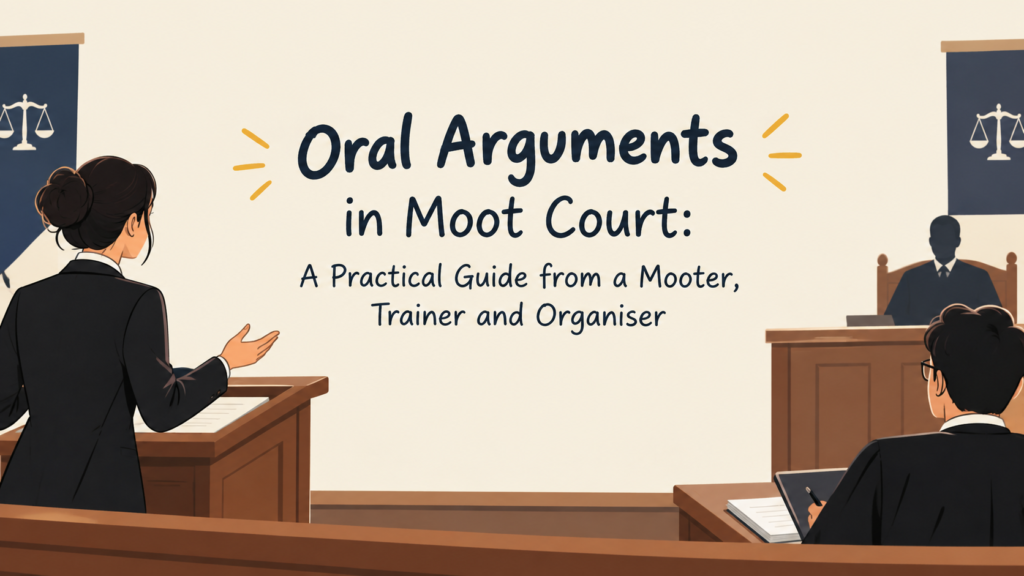

- Oral Arguments in Moot Court: A Practical Guide for Law Students
- Part I: Before the Moot — Prepare to Argue, Not Just to Memorise
- Part II: Entering the Court — How to Begin Your Oral Submissions
- Part III: Presenting Your Arguments
- Part IV: When the Bench Questions You
- Part V: How You Present Yourself Before the Bench
- Part VI: Dealing With Disagreement
- Part VII: Managing Time and Arguments
- Part VIII: Rebuttals
- Part IX: Closing Your Submissions
- Part X: The Things You Should Never Forget
Moot court competitions are often treated as an exercise in researching cases, drafting memorials and speaking before a panel of judges.
But there is something more fundamental that a moot teaches.
How do you stand before a court and make a case for your client?
A moot court is, in many ways, a smaller and more controlled version of what advocacy can look like in the real world scenario. You have a set of facts, a legal problem, a client whose interests you represent, an opposing side, and a bench that is not necessarily going to let you deliver your carefully prepared argument uninterrupted.
The judges will question you.
They may challenge your interpretation.
They may point out a gap in your argument.
They may take you somewhere you did not expect to go.
And you have to respond.
Having participated in and won several moot court competitions during law school, trained teams, convened the Moot Court Committee, and also been involved in organising moots, I have had the opportunity to look at mooting from several lens.
Oral Arguments in Moot Court: A Practical Guide for Law Students
This guide brings together some of the things I have learnt about oral arguments in moot court — from preparing your submissions and introducing your case to handling questions from the bench, presenting your arguments, rebutting the opposing side and closing your submissions.
Part I: Before the Moot — Prepare to Argue, Not Just to Memorise
1. Know Your Case. Really Know It.
Know the facts
- What happened?
- What led to the dispute?
- Where is the bone of contention?
- What legal action was taken?
- Why is the matter before this particular court?
Know the law
- Know your issues and propositions.
- Know the statutory provisions you rely upon.
- Know every important authority you have cited.
Know your case law
Don’t simply remember the name and citation of a case.
For every important case, prepare:
| Case | Brief facts | Issue/ Reasoning | Status (check if it is overruled) | Final decision | Relevance to your submission |
| 1. | |||||
| 2. |
Don’t collect authorities for the sake of numbers
A long list of cases is not necessarily a strong argument. Your authorities should actually support the proposition you are advancing and be relevant to your case.
One non-negotiable before the oral rounds is to read the memorial time and again. Not go through, or skim, read it, in full. You must know by now that facts from both sides are presented differently, not by altering them, but by altering the way you mention them.
Know your weaknesses
Read your own memorial critically. Identify loopholes, weak propositions and questions the bench is likely to ask.
Part II: Entering the Court — How to Begin Your Oral Submissions
2. Your Introduction Matters
Your opening should tell the bench who you are, whom you represent and where your submissions are going.
Begin formally:
“May it please the Court, the counsel on behalf of…”
Then clearly state:
- the side you represent;
- the jurisdiction/court;
- the issues you will address;
- what your co-counsel will address.
For example:
“Here is the counsel from the end of the petitioner/respondent. Counsel will be dealing with Issues 1 and 2, which are… and co-counsel will deal in furtherance with Issues 3 and 4, that is…”
If you are the second counsel
Briefly tell the bench:
- what the first counsel has already covered;
- which issues you will now address;
- how your submissions continue from the first counsel’s arguments.
This gives the bench a roadmap.
3. Seek Permission Before Reciting the Facts
Before beginning the factual background, seek permission to briefly recite the facts.
Keep the facts relevant to the dispute.
Explain:
- what happened;
- where is the bone of contention;
- why legal action was taken;
- why the matter has reached the present court.
The purpose is to give the bench the context necessary to understand your submissions — not to narrate the entire moot problem word-for-word.
Note: Practice reciting this under a minute at max.
Part III: Presenting Your Arguments
4. A Moot Is Not a Speech
You are not giving a speech to an audience.
You are making submissions to judges.
You are talking with the bench, not reading your memorial aloud.
Your objective is to make the judges understand:
- your position;
- the law supporting it;
- how that law applies to your facts;
- and why your submission should be accepted.
Use courtroom terminology naturally:
“We submit…”
“We humbly submit…”
“It is the counsel’s submission that…”
“The counsel contends…”
Counsel submits or contends; avoid treating the exercise like a conventional presentation.
5. Keep Your Language Simple
You do not need complicated English or excessive legal jargon to sound like a lawyer.
The purpose of oral advocacy is communication.
If the bench cannot easily understand your point, complicated terminology is not helping you.
Make the submission clear, direct and easy to follow.
Note: Practice speaking in front of a layman before the rounds.
6. Use the Point → Authority → Application → Conclusion Structure
For every major argument:
Step 1: Make the point
Tell the Court what you are submitting.
Step 2: Support it with authority
Refer to the relevant statute, principle or case law.
Step 3: Apply it to your facts
Explain why that authority applies to the present case.
Step 4: Conclude
Tell the Court what follows from your submission.
Step 5: Move to the next point
Use a connecting sentence so the transition is clear.
The Court should never have to wonder:
“Why are we suddenly talking about this?”
7. Keep Reminding the Bench Where You Are
Oral submissions can become difficult to follow when several issues and authorities are being discussed.
Help the bench follow your structure.
For example:
“Having dealt with Issue I, the counsel would now move to Issue II…”
or
“With this submission, the counsel has addressed the first limb of the issue. The counsel would now proceed to…”
Your job is not only to make the argument but also to make the argument easy to follow.
A little preparation beforehand on:
When the Judge Asks About Your Memorial
The judges will have your memorial with them. You do not need to keep repeating everything that is already written there.
But that does not mean you dont keep a tab with yourself. If the bench asks about a particular submission, you have to direct them to the relevant paragraph or page where appropriate.
But don’t turn every answer into:
“As stated in paragraph 24…”
Use the reference strategically — particularly when the point is one of your strongest submissions or when the bench seems particularly curious about it.
At the same time, there is a simple preparation trick that can save you when you are under pressure:
Always keep the paragraph numbers of your important submissions and authorities written alongside your oral argument script.
You may know your memorial inside out. But when a judge suddenly asks, “Counsel, where have you dealt with this?”, finding the exact paragraph while standing before the bench is a very different exercise.
Part IV: When the Bench Questions You
8. Let the Judge Finish
The moment a judge asks a question, stop.
Give the judge time to speak.
Never:
- interrupt;
- speak over the question;
- try to finish your prepared sentence;
- continue with your argument while the judge is speaking.
The bench is trying to understand and test you. Your ability to listen is as important as your ability to speak.
9. Pause Before You Answer
After the judge finishes speaking:
Pause. Take a breath. Then answer.
That small pause gives you time to understand the question and organise your response.
It also prevents nervous, impulsive answers.
If you have not understood the question, respectfully ask for clarification:
“I would be obliged if Your Honour would clarify the question.”
10. Answer the Question First
If the judge asks a direct question, answer it directly.
If the answer is yes or no, begin there.
“Indeed, Your Lordship…”
“Yes, Your Lordship…”
“No, Your Lordship…”
Then explain your answer.
Do not spend another two minutes delivering the argument you had planned while avoiding the question that was actually asked.
11. If You Know the Answer, Don’t Sound Uncertain
Mooting tests your ability to take pressure.
If you know the answer, say it confidently.
You do not need to sound aggressive. Confidence can be polite.
The bench should be able to distinguish between:
- genuine uncertainty;
- and a well-prepared counsel who is simply responding to a difficult question.
12. If You Don’t Know the Answer, Don’t Bluff
You will not always know the answer to every question. And as confident you are of your bluffing skills, please know it’s very evident to the judges, afterall they’ve been in your shoes too. Doesn’t they won’t appreciate a good turn-around.
If you do not know:
- don’t invent a case;
- don’t invent a legal proposition;
- don’t pretend to remember something you don’t;
- don’t give the judge an answer simply because you think it is what they want to hear.
It is better to acknowledge that you are unaware.
Where appropriate, you may seek an opportunity to make a calculated response.
13. If You Need to Deal With the Question Later
Sometimes the bench asks a question that is directly connected to an argument you intend to address later, or it’s part of what your other counsel would deal, or you running short on time.
You can respectfully indicate where you intend to deal with it:
“The counsel would like to deal with this contention after Argument No. …”
Or, where appropriate, pass the matter to your co-counsel.
For example:
“Excellent question, Your Lordship. The counsel would like to deal with this contention after Argument No. …”
The important thing is not to use your structure as an excuse to evade the question.
You can use the above references but its better anyday if you’re able to say a sentence or two, briefly to answer, and then redirect, letting them know when the detailed version would be dealt with.
Bonus point: Give the Bench a Bait
This is one of the little tricks I was taught at the law school.
Before you present an important contention, think like the judge.
Ask yourself:
If I were sitting on the bench and counsel made this submission, what would I question?
What is the obvious counter? What is the weakest link? What fact might the judge pick on? What happens if the judge asks, “But counsel, what about…?”
Then prepare for it.
And, sometimes, you can actually give the bench the bait yourself.
Bring up the point you know they are likely to question. Hand over the question to them in a platter.
The difference is that you have already would have the answer.
Instead of waiting for the judge to discover the vulnerability in your argument and being caught off guard, you acknowledge the point and immediately deal with it.
You have effectively invited the question — but on your terms. And now you’ve got the brownie points!
Of course, this does not mean deliberately handing the bench every weakness in your case. The trick is to identify the question that is most likely to arise on a particular contention, and be prepared to address it.
That is where preparation starts turning into wit.
Part V: How You Present Yourself Before the Bench
14. Your Voice Matters
Your voice should be:
- clear;
- confident;
- polite;
- audible;
- appropriately paced.
Avoid speaking too quickly simply because you are nervous.
Use voice modulation when you reach:
- an important proposition;
- a crucial fact;
- your strongest argument.
Your entire submission should not sound like one continuous paragraph.
15. Your Body Language Matters
Maintain appropriate eye contact with the bench.
Keep your body language professional but comfortable.
You do not need to look stiff or robotic.
The objective is to appear composed and engaged with the Court.
Always take permission of the judges while you’re leaving or entering the courtroom. Your etiquettes speak for themselves. Bow before the judge as and when required… it’s generally when you enter the room, or when you’re going towards the podium to present your arguments, or lastly, when you’re leaving the room.
Part VI: Dealing With Disagreement
16. Never Argue With the Judge
You can disagree with an observation from the bench. But disagree respectfully.
For example:
“I accept the Court’s point. However, it is the counsel’s submission that…”
Or:
“With due regard to the argument advanced, the counsel submits that…”
You are defending your case, not trying to win an argument against the judge.
17. Be Careful With “Must” and “Should”
When making a submission about what the Court ought to do, use language appropriate to the nature of your submission.
For example:
“The Court should consider…”
rather than automatically saying:
“The Court must…”
unless you are referring to an actual legal requirement.
Your language should accurately reflect whether you are:
- stating what the law requires; or
- making a submission about what the Court should accept or do.
The Court is honorable, it is supreme. As a counsel, you do not question it, or do anything that will hinder its reputation in any manner.
Part VII: Managing Time and Arguments
18. Don’t Rush Just to Finish
Running out of time can make a mooter panic. But finishing every argument is not the only objective.
Completion of every prepared point is not itself a marking criterion. If time is running short:
- prioritise your strongest points;
- shorten less important submissions;
- restructure your arguments;
- use the remaining time intelligently.
You may seek additional time where appropriate, but don’t use it simply because you want to mechanically finish every argument you prepared. And while you request for time from the judges, remember to be specific, how much time and why.
19. Be Ready to Restructure Your Submissions
Your speech must remain flexible.
If your co-counsel takes more time than expected, or the bench spends considerable time questioning one issue, you may have to change your plan.
Know your arguments well enough that you can:
- skip unnecessary repetition;
- shorten a submission;
- move a point;
- prioritise your strongest argument.
This is one reason why understanding the argument is more important than memorising the speech. It tests how you deal with impromptu situations.
Part VIII: Rebuttals
20. Structure Your Rebuttal
A rebuttal should not become a list of everything you disliked about the opposing counsel’s submissions.
Identify the important points that require a response.
You can begin:
“With due regard to the argument advanced…”
or:
“The opposing counsel’s argument overlooks that…”
Then explain:
- what the opposing counsel submitted;
- what that argument overlooks or gets wrong;
- the authority or reasoning supporting your response;
- why your submission should be accepted.
Keep the rebuttal focused and structured.
Part IX: Closing Your Submissions
21. Know When to Stop
Once your submissions are complete, don’t continue simply because you still have material left in your notes.
You can conclude:
“That concludes the submission. May the counsel be of any further assistance to the Court?”
Give the judges an opportunity to ask further questions.
If there are none, seek permission to proceed to the prayer.
And remember: a moot is a court submission, not a classroom presentation. There is no need to end with a presentation-style “thank you.”
It could be a different custom at your end, but for us, it was for the counsels as well as the researcher of the respective team, to stand at their respective places while keeping their hand on their heart, while one of the counsels say the prayer.
Its always a good practice to memorise the prayer.
Part X: The Things You Should Never Forget
22. A Quick Checklist Before You Step Up
Know
- Facts
- Issues
- Relevant law
- Authorities
- Your opponents’ likely arguments (skim through their memorial and figure out the rebuttals beforehand; the researcher can be a good helping hand for this one)
- Your own weaknesses
Prepare
- Case-law table
- Issue-wise arguments
- Authorities for every major proposition
- Flexible speaking structure
- Possible questions from the bench
- Rebuttal points
- Prayer
While speaking
- Introduce yourself and your side
- State your issues
- Seek permission for facts
- Use courtroom terminology
- Make one point at a time
- Support points with authority
- Apply authority to facts
- Keep the bench oriented
- Listen when the judge speaks
- Pause before answering
- Answer questions directly
- Admit when you don’t know
- Maintain clear voice and professional body language
- Don’t argue with the judge
- Manage your time intelligently
- Close properly
From the Other Side of the Table: What the Bench Is Testing
Judges are not necessarily going to let you follow the route you prepared. That’s part of their briefing.
In a moot, the bench may deliberately question you from different angles, challenge an authority you relied upon, pick at a factual gap, take you away from your prepared sequence, or keep you engaged on one point longer than you expected.
Sometimes, it may feel like the judges are trying to grill you, throw you off your route, or eat into your allotted time.
But that is precisely the point.
The exercise is not only to see whether you know the law. It is also to see what happens when things do not go according to your plan.
Can you be led away from your prepared route and still find your way back?
Can you disagree with the bench without becoming argumentative?
Can you answer an unexpected question without losing your train of thought?
Can you remain respectful and composed when you are under pressure?
Can you recognise that a particular argument is not working and move to a stronger one?
And, most importantly, can you still achieve what you came there to achieve?
A professor once told me that lawyers are shrewd.
I think a part of that shrewdness comes from exactly this process. You learn to listen carefully, understand where the question is taking you, decide what needs to be answered immediately and what can wait, and find your way back to your submission without losing your composure. You find a way or make a way.
That is the wit that mooting develops.
The real skill a moot is testing
In a real court, a lawyer is not going to get a perfectly uninterrupted five-minute slot to deliver a beautifully written submission. The bench will have questions. The opposing counsel will have a response. The facts may be messy. The law may not fit perfectly. And somewhere in all of that, counsel still has to make the best case possible for the client.
A moot gives law students a relatively safe place to start learning that skill.
So, when you stand before the bench, remember:
Make the point.
Support it with authority.
Apply it to the facts.
Conclude it.
Move forward.
And most importantly, remember what you are there to do.
You are not there to perform.
You are not there to read your memorial aloud.
In a moot court, you are there to win over the judges.
Research the judgment behind this post
Every case we cover is indexed with full text, citations and judge profiles on the main site.
Browse the Case Law Digest → Courts & Cases home
Follow Courts & Cases on GoogleSee more of our legal coverage in Google Search.
Add as Preferred Source